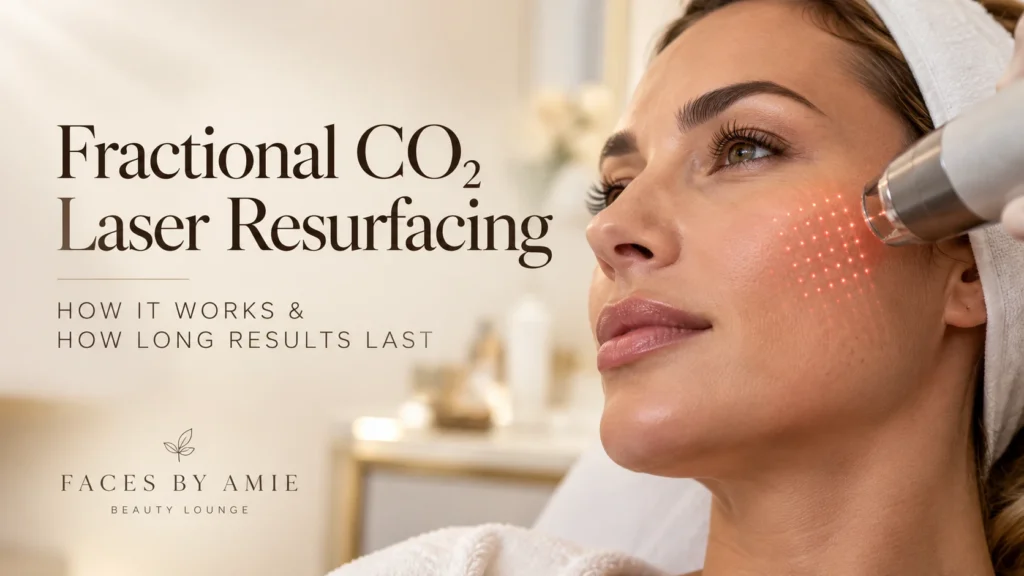
Fractional CO2 laser resurfacing is one of the most effective skin rejuvenation procedures available today. It uses a carbon dioxide laser operating at a 10,600nm wavelength to create thousands of microscopic channels in the skin, triggering the body’s own collagen rebuilding process. The result is smoother texture, reduced scarring, and visibly younger looking skin.
So how long do those results last? For most patients, the anti aging benefits hold for 3 to 5 years with proper skincare and sun protection. Scar improvements tend to be even more durable, often lasting permanently. But those numbers depend heavily on what you do after treatment, which is something most providers don’t explain in enough detail.
This post breaks down exactly how fractional CO2 laser resurfacing works at a tissue level, what the recovery process looks like week by week, and the specific factors that determine whether your results last 2 years or 10.
How Fractional CO2 Laser Resurfacing Works
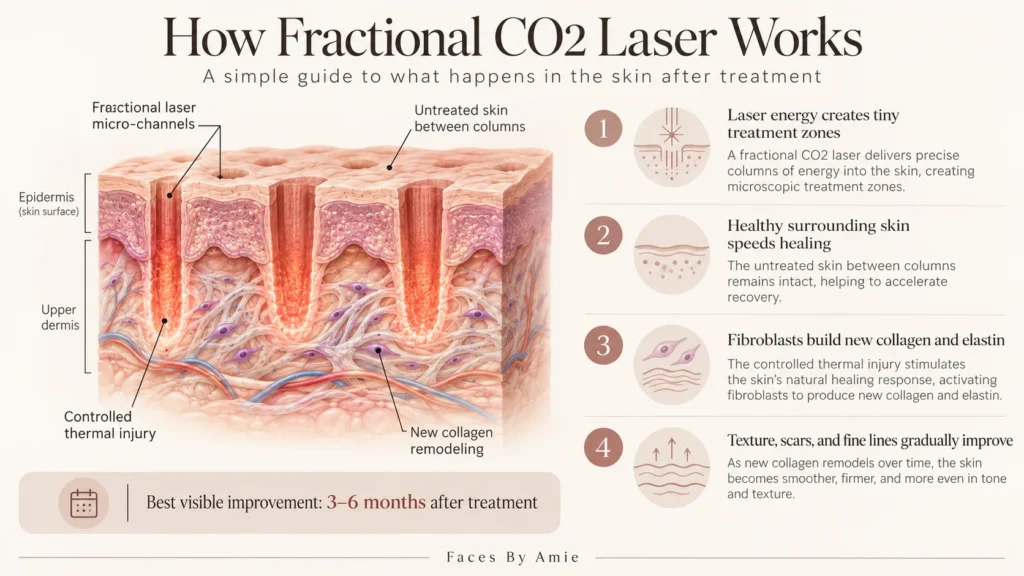
Every CO2 laser operates at a wavelength of 10,600 nanometers. At this wavelength, the laser energy is absorbed almost instantly by water molecules in your skin cells. Since skin tissue is roughly 70% water, the energy vaporizes targeted cells on contact.
What makes fractional CO2 different from older laser technology is precision. Instead of removing the entire skin surface (which is what traditional fully ablative CO2 lasers did), the fractional approach delivers the laser in a grid pattern of tiny columns. Each column is a microscopic treatment zone, typically 100 to 300 microns in diameter. The tissue between these columns stays completely untouched.
This matters for two reasons. First, the untouched skin acts as a healing reservoir. Healthy cells surrounding each treated column migrate inward to close the micro wounds rapidly, which is why fractional CO2 recovery takes 7 to 14 days instead of the 3 to 4 weeks that fully ablative treatments required. Second, the controlled thermal injury at the base of each column triggers a wound healing cascade that activates fibroblasts, the cells responsible for producing new collagen and elastin.
This process, called neocollagenesis, doesn’t just repair the treated columns. The new collagen production radiates outward, improving skin quality across the entire treated area. It’s why fractional CO2 can deliver results that approach fully ablative treatments with significantly less downtime and lower complication risk.
What Makes It “Fractional” and Why That Matters
The word “fractional” refers to the fact that only a fraction of the skin surface is treated during each pass. Depending on the device settings and the condition being treated, a fractional CO2 laser typically treats between 5% and 40% of the skin surface in a single session.
Traditional fully ablative CO2 lasers, which were the gold standard through the 1990s and early 2000s, removed 100% of the skin surface. The results could be dramatic. Deep wrinkles smoothed out, significant sun damage reversed, and substantial skin tightening occurred from a single treatment. But the trade offs were serious: recovery took 3 to 4 weeks, the risk of permanent pigment loss was high, and infection and scarring complications were more common.
Fractional technology changed the equation. A landmark Dermatologic Surgery study comparing both approaches found that while a single fractional treatment produced roughly half the collagen response of a single fully ablative treatment, the fractional approach achieved this with 78% to 95% less surface trauma. In practice, most patients reach comparable outcomes through 1 to 3 fractional sessions with far less risk.
That’s why fractional CO2 has largely replaced fully ablative resurfacing in modern dermatology and aesthetics. The procedure still uses the same powerful 10,600nm CO2 wavelength. The difference is in delivery, and that difference makes the treatment accessible to a much broader range of patients.
What Fractional CO2 Laser Actually Treats
Fractional CO2 resurfacing is most effective for conditions that involve damaged or disorganized collagen in the upper and mid layers of skin:
Fine lines and wrinkles, particularly around the eyes, mouth, and forehead, respond well because the new collagen fills in the structural gaps that cause creasing. Sun damage, including rough texture, hyperpigmentation, and age spots, improves as the laser removes damaged surface cells and triggers fresh skin turnover beneath them.
Acne scarring is one of the strongest indications for this treatment, but the type of scar matters. Shallow boxcar scars and rolling scars typically see 40% to 70% improvement over 2 to 3 sessions. However, deep ice pick scars and scars tethered to deeper tissue layers don’t respond as well to laser alone. Those usually need subcision or TCA CROSS first to release the scar from the underlying structure before laser resurfacing can smooth the surface.
Enlarged pores, uneven texture, and surgical or traumatic scars also fall within the treatment range. The key is that fractional CO2 works best when the problem sits within the depth the laser can reach, roughly the upper 1 to 2 millimeters of skin.
Recovery Timeline: What Happens Week by Week
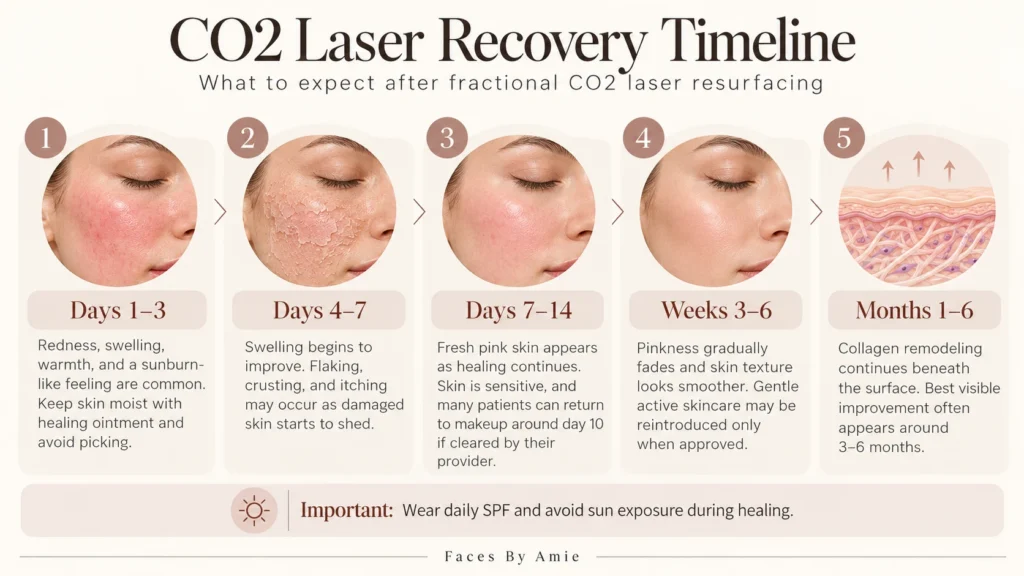
Recovery is one of the most searched aspects of CO2 laser resurfacing, and most sources give vague timelines. Here’s what actually happens at each stage and why.
Days 1 to 3 are the most intense. Expect significant redness, swelling, and a sensation similar to a strong sunburn. The treated skin may weep clear or slightly yellowish fluid, which is normal plasma and part of the healing response. Sleeping with your head elevated on two pillows helps reduce swelling. Your provider will prescribe a healing ointment that needs to be applied frequently to keep the skin moist. Letting it dry out and form a hard crust slows healing and increases scarring risk.
Days 4 to 7 bring visible change. Swelling starts to subside and a light crust or flaking layer forms as the treated tissue separates from the new skin growing beneath it. Itching is common and can be intense. This is the stage where discipline matters most: picking, scratching, or peeling the flaking skin can cause scarring, infection, and uneven results.
Days 7 to 14 are when new skin emerges. The crusts shed to reveal thinner, pinker skin that’s more sensitive than usual. Most providers clear patients for mineral based makeup around day 10, once they’ve confirmed the skin has fully re-epithelialized at a follow up visit. Temperature sensitivity and product sensitivity are normal during this stage.
Weeks 3 to 6 show progressive improvement. The pink tone gradually fades, and most patients feel comfortable returning to all normal activities. Your provider may reintroduce active skincare ingredients like retinoids or vitamin C during this window, depending on how your skin is healing. Strict sun protection with SPF 50 remains essential.
Months 1 to 6 are where the real transformation happens beneath the surface. Collagen and elastin remodeling continues long after the visible healing is done. Skin texture, firmness, and scar depth keep improving throughout this period. Most patients see their best results around the 3 to 6 month mark, though some continue to notice subtle improvements for up to 12 months.
Understanding this timeline is important because many patients judge their results too early. What your skin looks like at week 2 is not your final outcome. The collagen remodeling process needs months to complete, and the full picture doesn’t emerge until that process finishes.
How Long Do CO2 Laser Resurfacing Results Actually Last?
This is where the answer gets nuanced, because “results” means different things depending on what you’re treating.
For anti aging concerns like fine lines, wrinkles, and general skin texture, most patients maintain noticeable improvement for 3 to 5 years. The new collagen your body produces after treatment is real, structural collagen, not a temporary effect. But collagen naturally declines by roughly 1% per year starting in your mid twenties, and external factors like UV exposure accelerate that decline. So while the treatment resets the clock, the clock keeps ticking.
Scar improvements tend to be more permanent. When fractional CO2 remodels scar tissue, the structural changes to the collagen matrix are lasting. An acne scar that’s been smoothed through laser resurfacing doesn’t typically re-form. The skin around it continues to age normally, but the scar correction itself holds.
Sun damage reversal sits somewhere between these two. Pigmentation improvements can be long lasting with diligent sun protection, but continued UV exposure will generate new damage over time. This is why dermatologists call sun protection the single most important factor in maintaining laser results.
Optional touch up sessions every 12 to 24 months can extend and refresh results for patients who want to stay ahead of the natural aging curve. These maintenance sessions are typically lighter than the initial treatment, with shorter recovery times.
5 Factors That Shorten or Extend Your Results
The range between “results lasted 2 years” and “results lasted 7+ years” almost always comes down to these five variables.
Sun protection habits sit at the top of every list for good reason. UV radiation breaks down collagen and generates new pigmentation damage. Freshly remodeled skin is especially vulnerable in the months following treatment. Daily broad spectrum SPF 30 or higher isn’t optional; it’s what separates patients who hold their results from those who watch them fade prematurely.
Post treatment skincare routine plays a larger role than most patients realize. Once your provider clears you (usually around weeks 3 to 6), incorporating retinoids, vitamin C, and medical grade skincare products supports ongoing collagen production and protects the new skin. Patients who return to a basic cleanser and moisturizer routine often see faster regression than those who invest in active ingredients.
Treatment depth and intensity directly correlate with durability. Deeper fractional settings produce more aggressive collagen remodeling and longer lasting results, but they also require longer recovery. Your provider balances these factors based on your skin condition, tolerance for downtime, and treatment goals. A lighter session with faster recovery won’t last as long as a deeper treatment.
Smoking and lifestyle factors accelerate collagen breakdown through oxidative stress. Smokers consistently see shorter result duration across virtually every collagen stimulating treatment, not just CO2 laser. Chronic sleep deprivation, poor nutrition, and high stress levels contribute as well, though to a lesser degree.
Which area of the face was treated also matters. Skin around the eyes and mouth moves constantly through facial expressions, blinking, and speaking. That repetitive mechanical stress means fine lines in these areas tend to return earlier than improvements on the forehead, cheeks, or jawline where there’s less movement and often thicker skin.
How Many Sessions Does It Take?
Most patients achieve their goals in 1 to 3 sessions, but the number depends on what’s being treated and how the skin responds.
For general anti aging concerns like fine lines, sun damage, and texture improvement, a single session is often enough. The collagen remodeling from one well calibrated fractional CO2 treatment can produce significant visible improvement over the following 3 to 6 months.
Acne scarring typically requires 2 to 3 sessions spaced at least 3 months apart. That spacing isn’t arbitrary. New collagen takes 3 to 6 months to fully form, and assessing results before that window closes can lead to unnecessary additional treatments. A board certified provider will compare standardized photos taken in identical lighting at each follow up, because gradual improvements from session to session are easy to miss from memory alone.
There’s an important clinical principle here that most patients don’t hear: if two sessions produce no meaningful improvement, a third session of the same treatment is unlikely to change the outcome. At that point, the limitation isn’t the laser. It’s usually the scar type. Tethered rolling scars may need subcision to release them from deeper tissue, and narrow deep ice pick scars may require TCA CROSS or punch excision before the surface can be effectively resurfaced.
For patients with higher post inflammatory hyperpigmentation risk, particularly those with darker skin tones (Fitzpatrick IV to VI), providers often start with a small test patch before committing to a full treatment. This helps predict how the skin will respond and whether conservative settings or alternative treatments like microneedling or Morpheus8 would be a safer approach.
Frequently Asked Questions About CO2 Laser Resurfacing
Is fractional CO2 laser the same as Fraxel?
Not exactly. Fraxel is a brand name for a line of fractional lasers made by Solta Medical. The original Fraxel Re:pair uses CO2 technology, but other Fraxel models (like Fraxel Dual) use different wavelengths entirely. “Fractional CO2 laser” is the general category. Fraxel is one brand within it. Other common fractional CO2 platforms include the Lumenis UltraPulse, Alma Hybrid, and DEKA SmartXide.
How long does redness last after CO2 laser resurfacing?
Most patients see significant redness for the first 7 to 14 days, which transitions to a pink tone that gradually fades over weeks 3 to 6. Some patients, particularly those who received deeper treatments, may notice residual pinkness for up to 2 to 3 months. Mineral based makeup can typically cover it from around day 10 onward.
Can you do CO2 laser on darker skin tones?
Yes, but with important caveats. Darker skin tones (Fitzpatrick IV to VI) carry a higher risk of post inflammatory hyperpigmentation, meaning the skin can develop dark patches during healing. Experienced providers can mitigate this by using conservative energy settings and treating fewer passes, but the risk isn’t eliminated. For some patients, radiofrequency microneedling (like Morpheus8) or traditional microneedling may be recommended as safer alternatives that still stimulate collagen without the same pigmentation risk.
What’s the difference between fractional CO2 laser and microneedling?
Fractional CO2 is ablative, meaning it vaporizes tissue to trigger repair. Microneedling is non ablative, creating micro channels with fine needles without removing any skin. CO2 laser produces more dramatic results in fewer sessions (typically 1 to 2 vs 3 to 6 for microneedling) but requires 7 to 10 days of downtime compared to 1 to 2 days. CO2 is stronger for deep scarring and advanced sun damage. Microneedling is gentler, safer for darker skin tones, and works well for mild to moderate concerns. Many treatment plans use both in a staged approach.
Is one session of CO2 laser enough?
For many patients, yes. A single fractional CO2 session can produce significant improvement in fine lines, texture, and mild sun damage. Acne scarring and more advanced photoaging usually benefit from 2 to 3 sessions. Your provider will assess your specific concerns during a consultation and recommend whether a single treatment or a series will give you the best outcome.
When will I see final results after CO2 laser?
Visible improvement starts around weeks 2 to 3 as new skin settles in, but your final results won’t be apparent until collagen remodeling completes at the 3 to 6 month mark. Some patients continue to see subtle improvements for up to 12 months. This is why providers schedule follow up assessments at 3 months rather than judging outcomes earlier.