
Botox typically lasts three to four months for most people. Some patients get a solid five or even six months out of a single treatment, while others notice movement coming back closer to the two and a half month mark. The actual duration depends on where you get injected, how your body metabolizes the product, your activity level, and whether you have been getting treatments consistently over time.
That is the quick answer. But if you are researching this question, you probably want to understand why the range is so wide and what you can actually do to get the most out of every appointment. After 18 years of injecting and thousands of treatments across our Fairbanks, Anchorage, and Wasilla clinics, I have seen firsthand how differently Botox behaves from one person to the next. This article breaks down the real timeline, what the clinical research shows, and the practical steps that make a measurable difference in how long your results hold.
How Botox Actually Works (And Why It Wears Off)
Before we talk about duration, it helps to understand what Botox is doing at the muscle level. Botox (onabotulinumtoxinA) is a purified protein that temporarily blocks the nerve signals telling specific facial muscles to contract. When those muscles cannot fully contract, the skin above them stays smooth instead of folding into lines and wrinkles.
The key word there is temporarily. Your body gradually builds new nerve pathways around the blocked ones through a process called nerve sprouting. Once those pathways reconnect, the muscle starts firing again and movement returns. That process takes roughly three to four months in most people, which is why you land back in the treatment chair around that interval.
This is actually a feature, not a flaw. Temporary results mean your provider can adjust your treatment over time as your face changes and your preferences evolve. You are never locked into a look you do not love.
The Real Timeline: What Happens After Your Injection
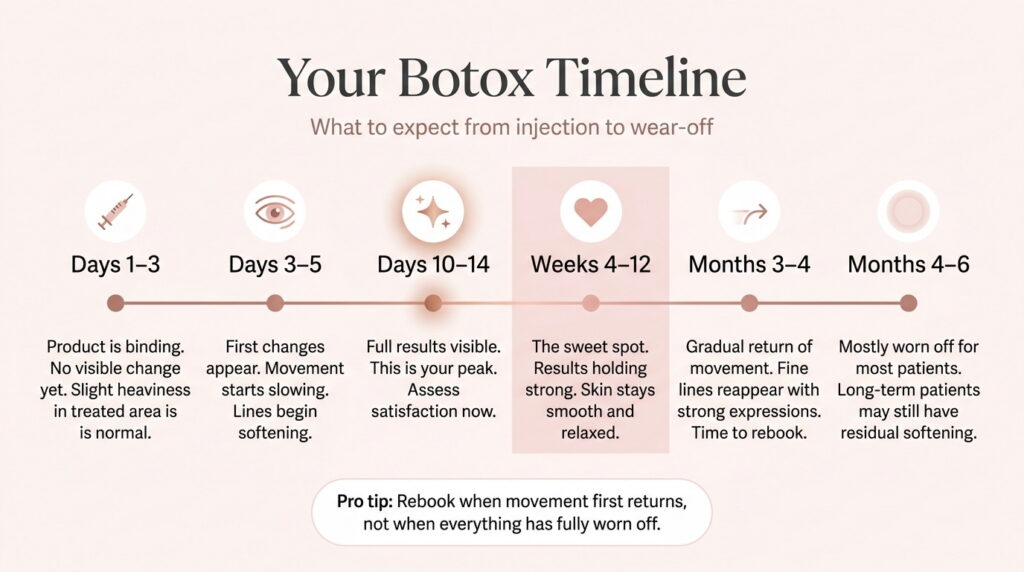
Here is what to expect from the moment you leave the office.
Days 1 through 3. Most patients do not notice anything yet. The product is binding to nerve receptors, but it has not taken full effect. You might feel a slight heaviness in the treated area. This is normal.
Days 3 through 5. You start to see the first changes. Movement in the treated muscles begins to slow down. Forehead lines start to soften. Crow’s feet become less pronounced when you smile.
Days 10 through 14. Full results are visible. This is what your treatment will look like at its best. If you are not satisfied with the results at the two week mark, that is the time to call your provider for a touch up assessment.
Weeks 4 through 12. The sweet spot. Your results are holding strong. Skin stays smooth. Lines stay relaxed. This is the window most people enjoy their treatment the most.
Months 3 through 4. Gradual return of movement. You will notice small expressions coming back first. Fine lines may start to reappear with strong expressions but remain softer at rest. This is a sign to start thinking about your next appointment.
Months 4 through 6. For most patients, Botox has largely worn off by this point. Muscle movement is close to baseline. Some long term patients will still have residual softening here, especially if they have been consistent with treatments for over a year.
How Long Does Botox Last by Treatment Area?
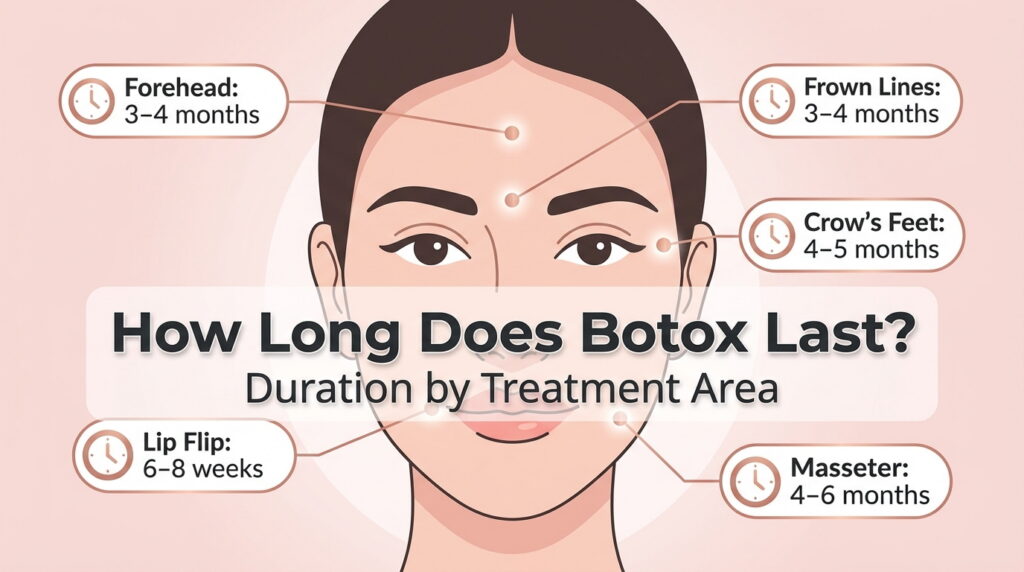
Not all facial muscles are created equal. The area you treat significantly affects how long your results last. Larger, more active muscles tend to metabolize Botox faster than smaller ones.
Forehead Lines
Three to four months is standard for the frontalis muscle. This is one of the most actively used muscles on your face. You raise your eyebrows dozens of times a day without even thinking about it. That constant activity means the nerve pathways rebuild relatively quickly. Some patients with very strong forehead muscles see results fade closer to the three month mark.
Frown Lines (the 11s)
The corrugator and procerus muscles between your brows typically hold Botox for three to four months as well. These are strong muscles, but because the area is small and the injection is concentrated, many patients report this area lasting a bit longer than the forehead.
Crow’s Feet
The orbicularis oculi muscle around your eyes responds well to Botox and results often last three to four months. A landmark study published in Dermatologic Surgery followed 1,362 patients across two Phase 3 clinical trials and found a median response duration of 119 to 148 days for crow’s feet treatment. That works out to roughly four to five months of visible improvement (Baumann L, et al. Dermatol Surg. 2016;42(5):598-607).
Lip Flip
This one is the outlier. A Botox lip flip uses a small number of units in the orbicularis oris muscle around the mouth. Because the dose is low and you use your mouth constantly for eating, drinking, and talking, results typically last only six to eight weeks. If you love the lip flip look, expect to come in more frequently than you would for other areas.
Masseter (Jawline Slimming)
On the opposite end, masseter Botox for jaw slimming or TMJ relief often lasts four to six months. The masseter is a large, powerful muscle, but it requires higher doses of Botox which contributes to the longer duration. Patients who have been getting consistent masseter treatments for over a year sometimes report results lasting even longer as the muscle gradually reduces in size from disuse.
Hyperhidrosis (Excessive Sweating)
When Botox is used for excessive sweating in the underarms, results can last six months or longer. The mechanism is slightly different since Botox is blocking sweat glands rather than muscle contractions, and the turnover rate for those nerve endings tends to be slower.
Why Botox Lasts Longer the More You Get It
This is something I explain to nearly every new patient. Your first Botox treatment will probably not last as long as your fifth or your tenth. There is a real reason for that.
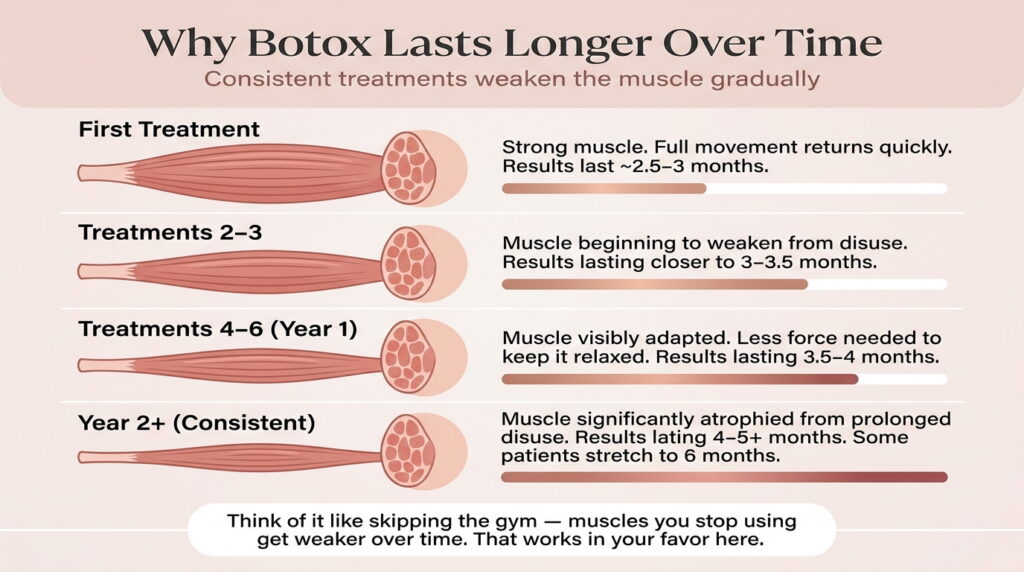
When you get Botox consistently over time, the targeted muscles weaken from prolonged disuse. Think of it like this: if you stopped going to the gym for a year, your biceps would shrink. The same principle applies to your facial muscles. Muscles that have been relaxed repeatedly become smaller and weaker, which means they take longer to return to full strength after each treatment.
A 2025 study published in Dermatologic Surgery confirmed this mechanism. Researchers found that patients receiving long term consecutive onabotulinumtoxinA injections experienced progressive muscle atrophy, which extended the interval between needed treatments over time.
This is why your first treatment might last two and a half to three months, but after a year of consistent treatments every three to four months, you might find yourself comfortably stretching to four or even five months between appointments. It is one of the best arguments for staying on a regular schedule rather than waiting until everything has fully worn off before rebooking.
What Affects How Long Your Botox Lasts
Several factors influence your individual timeline. Some you can control, and some you cannot.
Your Metabolism
People with faster metabolisms tend to process Botox more quickly. This includes people who exercise intensely and frequently. A review in The PMFA Journal found that vigorous exercise raises systemic metabolism and, as a consequence, decreases the efficacy time of botulinum toxin. If you are someone who does CrossFit, long distance running, or other high intensity training regularly, you may find your Botox wearing off on the earlier side of the three to four month window.
Living in Alaska, many of our patients at Faces By Amie are active outdoors year round. Hiking, skiing, snowboarding, fishing. I see this play out regularly. It does not mean Botox will not work for you. It just means we might adjust your dosing or schedule your follow ups a bit sooner.
Muscle Strength and Size
Stronger, larger muscles chew through Botox faster. Someone with a very expressive face and powerful muscle movement will typically see results fade sooner than someone with naturally delicate facial movement. This is also why men often need higher doses than women and may notice a shorter duration per treatment.
Dosage and Injection Technique
This one matters more than most people realize. Underdosing is the most common reason for Botox not lasting as long as it should. A provider who uses too few units trying to save you money is actually costing you more in the long run because you will need to come back sooner. Proper dosing matched to your muscle strength and anatomy is essential.
Injection placement matters too. Botox placed precisely into the belly of the target muscle performs differently than product placed too superficially or too far from the muscle center. This is where your injector’s experience and training make a significant difference.
Sun Exposure and Heat
UV exposure and prolonged heat (saunas, hot yoga, prolonged sun exposure) in the first 24 to 48 hours after treatment can affect how Botox settles. After the initial period, sun damage over time degrades your skin quality independently of Botox, which can make lines appear more prominent even while the product is still working.
Stress
Chronic stress elevates cortisol, which increases inflammation and can accelerate the breakdown of Botox. I realize telling someone to “stress less” is not particularly helpful, but it is worth knowing that managing your stress through sleep, exercise, and general self care has real effects on how your treatments hold up.
Botox Compared to Other Neuromodulators
Botox (onabotulinumtoxinA) is the most well known neuromodulator, but it is not the only option. Different formulations have slightly different profiles when it comes to onset and duration.
Dysport (abobotulinumtoxinA) tends to kick in a day or two faster than Botox and spreads across a slightly wider area. Duration is comparable at roughly three to four months, though some patients report it wearing off slightly sooner.
Xeomin (incobotulinumtoxinA) is a “naked” neurotoxin with no accessory proteins. It has a similar three to four month duration but may be a good option for patients who have developed resistance to other formulations.
Daxxify (daxibotulinumtoxinA) is the newest option and the most interesting from a longevity standpoint. In FDA clinical trials, Daxxify demonstrated a median duration of six months, with some patients maintaining results for up to nine months. It achieves this through a unique peptide delivery system that helps the molecule bind more effectively at the nerve junction.
If duration is a priority for you, it is worth asking your provider about which neuromodulator best fits your goals. During a complimentary consultation at any of our locations, we can walk through the differences and help you decide.
When Botox Stops Working: Antibody Resistance
This is something almost nobody talks about, but it is real. A small percentage of patients develop neutralizing antibodies to botulinum toxin over time. Your immune system essentially learns to recognize and deactivate the protein before it can do its job.
The risk increases with frequent treatments at short intervals and with subtherapeutic (too low) dosing. The PMFA Journal review identified this as a documented clinical phenomenon called secondary nonresponse, where Botox works initially but becomes progressively less effective over months or years of use.
If you feel like your Botox is lasting less and less with each treatment despite consistent dosing, talk to your provider. Switching to a different formulation (like Xeomin, which has fewer accessory proteins) can sometimes resolve the issue.
How to Make Your Botox Last Longer
You have more control over your results than you might think.
Stay on schedule. The single most effective thing you can do is maintain consistent treatments. Do not wait until everything has fully worn off. Rebooking while you still have some residual effect helps train the muscles to stay relaxed longer over time.
Protect your skin from the sun. Wear SPF 30 or higher daily. Sun damage breaks down collagen and makes wrinkles more visible independently of whether your Botox is still active. In Alaska, this matters just as much in winter since UV reflects off snow.
Avoid intense exercise for 24 hours after treatment. Elevated heart rate and blood flow can cause the product to migrate or metabolize before it fully binds to the nerve receptors.
Sleep on your back the first night. Pressure on treated areas in the hours after injection can shift product placement.
Stay hydrated. Proper hydration supports your skin’s overall health and appearance, which complements what Botox does at the muscle level.
Do not smoke. Smoking accelerates skin aging and breakdown of collagen. It also impairs blood flow to the skin. Patients who smoke consistently report shorter Botox duration compared to non smokers.
Consider complementary treatments. Combining Botox with treatments that address skin quality rather than just muscle movement can extend your overall results. Microneedling, chemical peels, or Morpheus8 RF microneedling build collagen and improve skin texture, which means your skin looks better between Botox treatments and the lines that do come back are less pronounced.
When to Schedule Your Next Appointment
The ideal time to rebook is when you start to notice the first signs of movement returning, not when everything has fully worn off. For most patients, that means scheduling your next appointment around the three month mark.
Here is a general maintenance schedule based on what I see with my patients:
First year of treatment: Every three months. This builds the muscle weakening effect and establishes your baseline.
After one to two years of consistent treatment: You can often extend to every three and a half to four months as the muscles adapt.
Long term patients (two plus years): Some patients comfortably go four to five months between treatments. A few even stretch to six months for certain areas.
Keep in mind these are averages. Your individual schedule should be based on what you and your provider observe about how your muscles respond.
Frequently Asked Questions
How long does Botox last the first time?
First time patients typically see results lasting two and a half to three months. This is shorter than average because the muscles have not yet been weakened from repeated treatment. By your third or fourth session, most patients notice their results holding for the full three to four month window.
Can Botox last 6 months?
Yes, though it is not the norm for most treatment areas. Masseter Botox and hyperhidrosis treatment commonly last four to six months. For cosmetic areas like the forehead and crow’s feet, six months is possible in long term patients with well conditioned muscles but three to four months is the standard expectation.
Does Botox last longer in the forehead or crow’s feet?
They are similar, but crow’s feet may edge out slightly longer results. The Baumann et al. clinical study found median response duration of 119 to 148 days (roughly four to five months) for crow’s feet. Forehead results typically fall in the three to four month range because the frontalis is a larger and more frequently used muscle.
What happens when Botox wears off?
Your muscles gradually regain full movement and the lines that were softened will slowly return. Your face does not suddenly snap back. The return of movement is gradual over several weeks. Importantly, your wrinkles will not be worse than they were before treatment. If anything, they may look slightly better because the muscles have been resting.
How often should I get Botox?
Every three to four months is the standard recommendation. Going more frequently than every three months is generally not advised as it increases the risk of developing antibody resistance. Going much longer than four to five months means you lose the cumulative muscle weakening benefit.
Does exercise make Botox wear off faster?
It can. High intensity exercise raises your metabolic rate, which can accelerate how quickly your body breaks down the botulinum toxin. This does not mean you should skip the gym. It just means that if you are a serious athlete or do intense workouts daily, you may find yourself on the shorter end of the three to four month duration.
Is it bad to get Botox for years?
No. Long term use is well studied and considered safe. A 2025 study in Dermatologic Surgery examining consecutive long term onabotulinumtoxinA use found that repeated treatment leads to muscle atrophy that actually extends the interval between needed sessions. Many providers, including myself, have patients who have been getting Botox consistently for 10 to 15 years with no adverse long term effects.
Why is my Botox not lasting as long as it used to?
There are several possible reasons. Your dosage may need adjustment. Your body may have increased its metabolic rate through changes in exercise or stress levels. In rare cases, you may be developing neutralizing antibodies. Talk to your provider about switching formulations or adjusting your dose before assuming the product has stopped working for you.