
PRP hair restoration uses concentrated platelets from your own blood to reactivate hair follicles that have started to thin. A small blood sample is drawn, spun in a centrifuge to separate the platelet rich plasma, and then injected directly into thinning areas of the scalp. The growth factors inside those platelets stimulate new blood vessel formation around the follicle, extend the active growth phase, and can improve hair density over several months.
If you’re considering PRP for hair loss, this post explains exactly what happens at a biological level to trigger regrowth, what a treatment session looks like from start to finish, and what the weeks and months after treatment actually feel like.
How PRP Hair Restoration Works at the Cellular Level
PRP stands for platelet rich plasma. Platelets are tiny cell fragments in your blood that are best known for clotting wounds, but they also carry hundreds of proteins called growth factors. When concentrated and injected into the scalp, these growth factors interact directly with the cells responsible for hair production.
Here’s what each key growth factor does:
VEGF (Vascular Endothelial Growth Factor) builds new blood vessels around the hair follicle. Thinning hair is partly a circulation problem. As follicles miniaturize, the blood supply feeding them weakens. VEGF helps reverse that by creating new pathways for oxygen and nutrients to reach the follicle base.
PDGF (Platelet Derived Growth Factor) triggers cell multiplication in the dermal papilla, which is the small cluster of cells at the very bottom of each hair follicle that controls the growth cycle. When dermal papilla cells multiply, the follicle gets stronger signals to produce thicker, healthier hair.
IGF-1 (Insulin Like Growth Factor 1) keeps follicles in the anagen phase longer. Anagen is the active growth phase when hair is physically getting longer. In pattern hair loss, follicles spend less and less time in anagen and more time resting. IGF-1 helps extend that growth window.
EGF (Epidermal Growth Factor) supports the outer root sheath cells that protect the hair strand as it grows. Think of it as reinforcing the structure around the hair so it can grow without breaking or thinning prematurely.
These growth factors don’t work in isolation. When they’re released together from concentrated platelets, they activate a signaling pathway called Wnt/beta-catenin. This is the same pathway that tells stem cells in the hair follicle to wake up and start producing hair. In androgenetic alopecia (the most common type of hair loss in both men and women), a hormone called DHT suppresses this pathway. PRP essentially works against that suppression by reactivating the signal from the other direction.
The biological response also includes reduced inflammation around the follicle and new collagen formation in the dermal layer surrounding each hair. Both of these changes create a healthier environment for the follicle to function in.
One thing worth knowing: PRP isn’t FDA cleared specifically for hair growth. The centrifuge devices used to prepare PRP are FDA cleared, but the procedure itself is used off label for hair restoration. That’s standard in regenerative medicine and doesn’t mean the treatment is unproven. Multiple clinical studies and meta-analyses support its effectiveness. A review of 43 randomized controlled trials involving 1,877 participants found that PRP produced significant improvements in hair density, with 70% to 80% of patients in early to moderate hair loss showing measurable results.
What Happens During a PRP Hair Restoration Session
Understanding the full process helps take the uncertainty out of your first appointment. Here’s what each step involves.
Before your session, your provider will give you prep instructions. The most important ones: drink plenty of water in the days leading up to your appointment (hydration affects blood draw quality and platelet yield), stop taking anti-inflammatory medications like ibuprofen, aspirin, and naproxen at least one week before treatment (these interfere with platelet function), and pause blood-thinning supplements including fish oil, vitamin E, garlic, and ginkgo biloba at least five days out.
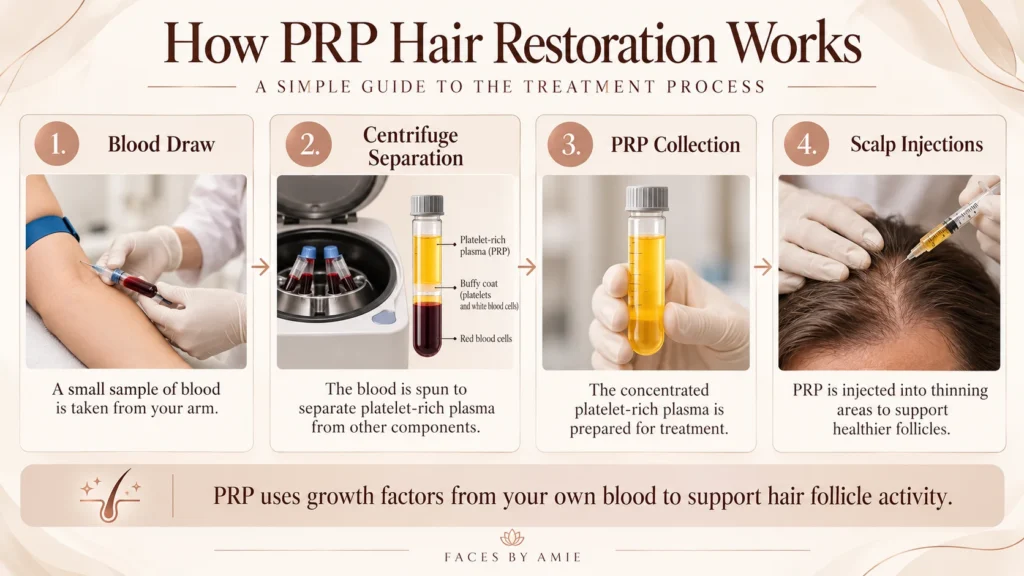
The blood draw is the starting point. Your provider draws roughly 30 to 60 milliliters of blood from your arm using a standard venipuncture, the same process you’d experience during routine lab work. The amount depends on the size of the treatment area and the PRP preparation system your clinic uses.
Centrifugation is next. The blood goes into a specialized centrifuge that spins it at high speed for approximately 10 minutes. This separates the blood into three layers: red blood cells settle at the bottom, a thin layer of white blood cells and platelets (called the buffy coat) sits in the middle, and platelet poor plasma rises to the top. The middle layer is what gets extracted. The goal is to concentrate platelets to roughly 4 to 5 times their normal level in your blood, reaching a target of about 1 to 1.5 million platelets per microliter.
Numbing the scalp happens while the blood is spinning. Your provider applies a topical anesthetic to the treatment area. Some clinics use a lidocaine and tetracaine cream, while others may use local anesthetic injections for deeper numbing. This step takes about 15 to 20 minutes to fully take effect.
The injection process is the core of the treatment. Using a fine gauge needle (typically 30 gauge), your provider injects the concentrated PRP into the scalp at approximately 1 centimeter intervals across the thinning area. The injections go to a depth of about 1.5 to 2 millimeters, which places the growth factors right at the level of the dermal papilla cells and the follicular bulge where stem cells live. Most patients describe the sensation as mild pressure or a slight pinch. Some areas of the scalp, particularly near the temples and along the hairline, tend to be more sensitive.
The entire appointment typically takes 45 to 60 minutes from blood draw to final injection. There are no incisions, no stitches, and no bandages. Most people drive themselves home.
At Faces By Amie, PRP hair restoration can also be combined with proprietary protocols like BIOHAIR and DE|RIVE, which pair PRP with scalp microneedling and growth factor serums for enhanced follicle stimulation.
What to Expect After Your PRP Session
PRP has essentially zero downtime. You can go back to work and normal daily activities the same day. But your scalp does need specific care in the hours and days after treatment to get the best possible results.
The first 24 hours are about leaving the treatment area alone. Don’t wash your hair, touch your scalp, or apply any products. Some redness, mild swelling, and tenderness at the injection sites is completely normal and usually fades within a day or two. If you need pain relief, stick with acetaminophen (Tylenol). Avoid ibuprofen and aspirin because they can interfere with the platelet activity you’re trying to promote.
Days 2 to 3: You can gently wash your hair with a sulfate free, fragrance free shampoo and lukewarm water. Pat dry instead of rubbing. Skip the gym, hot yoga, saunas, and steam rooms. Avoid alcohol for at least 72 hours.
Days 3 to 5: Stay out of direct sun and wear SPF 30 or higher on any exposed scalp. Don’t use styling products, gels, sprays, or serums on the scalp. Avoid heated styling tools. Pause blood-thinning supplements (fish oil, garlic, ginkgo, high-dose vitamin E) if you haven’t already.
Days 7 to 14: Continue avoiding NSAIDs for at least a full week. No hair coloring, bleaching, relaxers, perms, or keratin treatments for a minimum of 14 days after treatment. These chemicals can irritate the scalp and potentially interfere with the healing response.
Week 2 and beyond: Most patients are back to their completely normal routine by this point. Some people notice a temporary increase in shedding around weeks 2 to 6. This can feel alarming, but it’s actually a sign the treatment is working. PRP pushes resting follicles into a new growth cycle, and the old hairs that were already in the shedding phase fall out to make room for new growth.
When You’ll See Results and How Many Sessions You Need
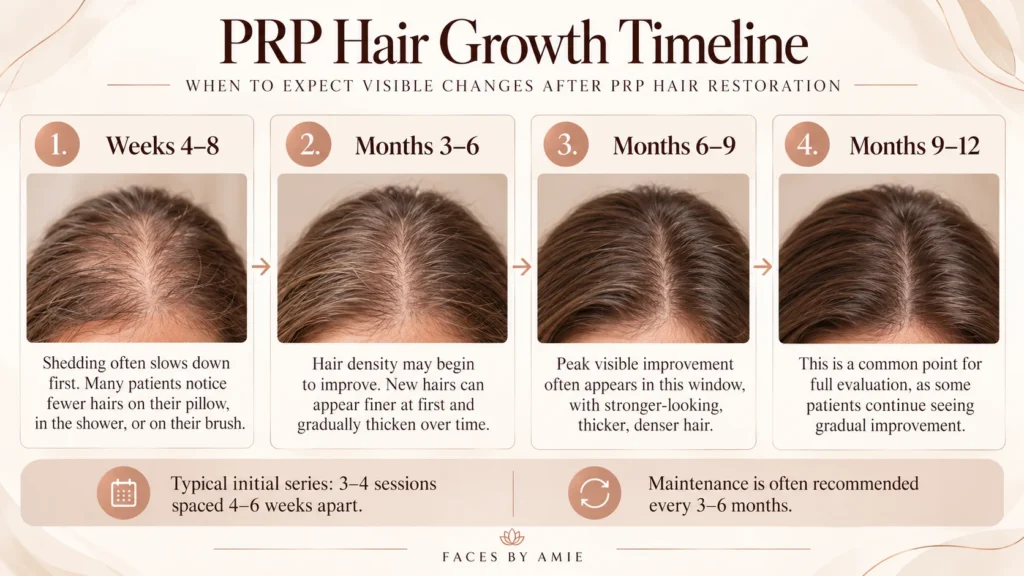
PRP is not an overnight fix. The biological processes it triggers, new blood vessel formation, cell multiplication, and extended growth phases, take time to produce visible changes.
Weeks 4 to 8: Reduced shedding is usually the first sign. You’ll notice fewer hairs on your pillow, in the shower drain, and on your brush. This happens because PRP extends the anagen phase, keeping more follicles in active growth instead of transitioning to the resting and shedding phases.
Months 3 to 6: This is when density changes start becoming visible. New hairs emerge that are finer at first and gradually thicken. Existing hairs may appear stronger and more resilient. Clinical studies show an average increase of 25 to 45 additional hairs per square centimeter in this window.
Months 6 to 9: Peak improvement. Hair is visibly thicker and denser across the treated area. This is when before and after comparisons show the most dramatic difference.
Months 9 to 12: Full evaluation point. Some patients continue to see gradual improvement through month 12 as collagen remodeling around the follicles matures.
The standard protocol is 3 to 4 initial sessions, spaced 4 to 6 weeks apart. This loading phase builds a concentrated biological response in the scalp tissue. After the initial series, most patients transition to maintenance sessions every 3 to 6 months to sustain results. Without maintenance, the benefits typically begin fading around 12 to 18 months because the underlying factors causing hair loss (hormonal changes, genetics) are still present.
It’s also worth setting realistic expectations. About 20% of patients are considered non-responders, meaning they don’t see significant improvement. Factors that affect response include the degree of hair loss (early to moderate thinning responds much better than advanced baldness), age, genetics, and overall health. If you don’t see improvement after 6 months and two to three sessions, your provider should reassess the approach.
Who Should Get PRP Hair Restoration (and Who Shouldn’t)
PRP works best for people with active but weakened follicles. If a follicle has gone completely dormant and the scalp in that area is smooth and shiny with no fine vellus hairs visible, PRP likely can’t bring it back. The treatment strengthens existing follicles rather than creating new ones from nothing.
Good candidates generally include people with androgenetic alopecia (male or female pattern hair loss) in early to moderate stages, women experiencing postpartum shedding or hormonal thinning related to menopause or thyroid changes, people dealing with stress-related telogen effluvium, and patients looking to enhance results from other treatments like microneedling or topical therapies.
PRP can be particularly effective for women’s hair loss because the diffuse thinning pattern common in female pattern hair loss (spread across the top of the scalp rather than concentrated in a receding hairline) means there are typically more active follicles available to respond to treatment. A systematic review of 21 studies found PRP significantly improved hair density and thickness in female patients.
PRP is not recommended for people with blood disorders or platelet dysfunction syndromes, anyone on anticoagulant therapy that can’t be paused, people with active scalp infections or skin conditions at the treatment site, patients with uncontrolled diabetes, those undergoing active cancer treatment, pregnant women, people with severe anemia (hemoglobin below 10 g/dL), and anyone who has had a corticosteroid injection at the treatment site within the past month.
If you take immunosuppressive medications or have an autoimmune condition like lupus or rheumatoid arthritis, consult with your provider about whether PRP is appropriate for your situation. These conditions don’t automatically disqualify you, but they require careful evaluation.
People with completely bald or scarred areas, where the follicles are truly gone, won’t benefit from PRP alone. In those cases, a hair transplant may be a better option, and PRP can be used as an adjunct to improve transplant graft survival rates.
Frequently Asked Questions About PRP Hair Restoration
Does PRP hair restoration hurt?
Most patients rate the discomfort as mild. The blood draw feels like any standard lab draw. The scalp injections feel like small pinches or mild pressure, especially after the numbing cream has taken effect. The temples and hairline tend to be the most sensitive areas. On a scale of 1 to 10, most people report the injection portion as a 3 to 5. The entire process takes 45 to 60 minutes, and any discomfort ends as soon as the last injection is done.
How much does PRP hair restoration cost?
PRP hair restoration generally ranges from $500 to $2,500 per session nationally, depending on the provider, geographic location, the preparation system used, and the size of the treatment area. A full initial series of 3 to 4 sessions typically runs between $1,500 and $4,500, with annual maintenance adding $1,000 to $2,500 per year. These are general industry figures and not specific to any one clinic. Insurance rarely covers PRP for hair loss since it’s considered an elective procedure. Schedule a complimentary consultation to discuss pricing and treatment plans tailored to your situation.
Can you combine PRP with other hair restoration treatments?
Yes, and combination approaches often produce better results than PRP alone. PRP combined with microneedling can improve absorption by up to 25% because the micro channels created by the needling device allow growth factors to penetrate deeper into the scalp tissue. PRP also pairs well with topical minoxidil and oral finasteride. Clinical studies show that PRP plus minoxidil can outperform either treatment used alone for both density and thickness improvements.
Is PRP FDA approved for hair loss?
No. PRP is used off label for hair restoration. The centrifuge devices used to prepare PRP are FDA cleared, but the FDA has not specifically approved PRP as a hair loss treatment. This is common in regenerative medicine. The clinical evidence supporting PRP for hair loss comes from randomized controlled trials, systematic reviews, and meta-analyses published in peer reviewed dermatology journals, not from an FDA approval process.
Can women get PRP for hair loss?
Absolutely. PRP is one of the most effective nonsurgical options available for female pattern hair loss. Women often respond well because their thinning pattern (diffuse across the top of the scalp) typically preserves more active follicles that can be stimulated. PRP is also used for postpartum shedding, hormonal thinning related to menopause or thyroid changes, and stress-related telogen effluvium. The treatment is safe for women of childbearing age, though it should be postponed during pregnancy.
How long do PRP results last?
Results from a full initial series typically last 12 to 18 months. Without maintenance sessions, the benefits gradually fade because the underlying causes of hair loss (genetics, hormones) continue working. Most providers recommend maintenance treatments every 3 to 6 months to sustain results long term. With consistent maintenance, many patients maintain their improvements for years. About 80% of patients sustain their gains for 2 or more years with ongoing treatment.
What’s the difference between PRP and PRF for hair?
PRF (platelet rich fibrin) is the next generation of platelet therapy. While PRP uses an anticoagulant during processing, PRF is processed without one, which creates a fibrin matrix that releases growth factors more slowly over time. Some providers believe this sustained release gives PRF a longer acting effect. Both treatments use your own blood and target the same biological pathways. Faces By Amie offers both PRP and PRF for hair restoration, and your provider can help determine which approach best fits your needs.